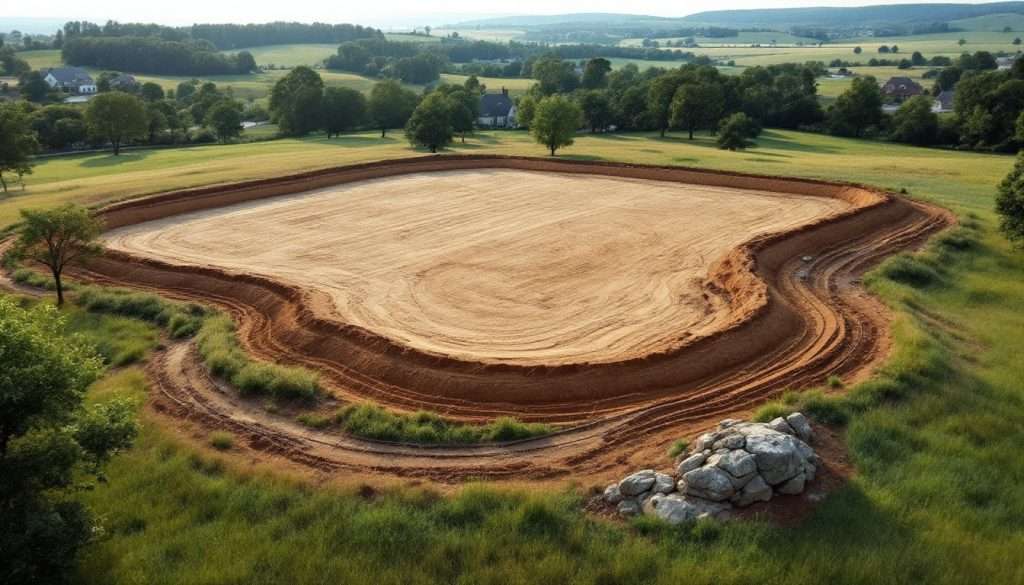
Ask ten contractors in Greene County when the best time to rough grade a site is, and you’ll get ten answers. But after years of pushing dirt across Springfield, Nixa, Ozark, Republic, and the rural stretches out toward Fair Grove, I can tell you the honest answer: timing matters more here than in almost any other part of Missouri. Our combination of heavy clay subsoil, chert-laden topsoil, karst bedrock, and roughly 45 inches of annual rainfall means that the same grading job can cost dramatically different amounts depending on whether you break ground in April or in October. This article breaks down how the calendar affects rough grading on Springfield-area sites and how to plan around it.
Rough grading is all about moving soil to design elevations and compacting it so it will hold. Moisture content is the single biggest variable in whether that compaction works. Southwest Missouri soils, particularly the red clay found under much of Greene and Christian County, have a narrow optimum moisture window. Too wet and the material pumps under a loaded scraper, refusing to take compaction no matter how many passes a sheepsfoot roller makes. Too dry and the clay turns into concrete clods that won’t knit together without a water truck running all day.
Layer on top of that our karst geology. Water that soaks into a saturated site doesn’t always drain away evenly. It finds fractures, old sinkhole throats, and solution channels in the Burlington limestone, and it can keep a pad soft for weeks after the rain gauge went dry. I’ve seen sites off South Campbell and out near Battlefield stay unworkable ten days after a one-inch storm while a site five miles away on shallower rock dried out in two.
April and May are the months most homeowners and developers call us. The weather is pleasant, builders want to start, and nobody wants to lose a construction season. Unfortunately, spring is also when Springfield gets hammered. April and May regularly deliver four to five inches of rain each, often in concentrated storm events that dump an inch or more in an afternoon.
Grading in spring is absolutely doable, but it comes with a different cost structure:
If you have to grade in spring, the smart move is phasing. Open only the area you can finish and stabilize in a short window rather than stripping the whole parcel and letting it sit exposed through a thunderstorm cycle.
From roughly mid-August through early November, Springfield gives us our most reliable grading weather. Rainfall tapers, evaporation rates stay high into September, and the soil holds a workable moisture content far more consistently. September and October are when we schedule our most demanding cut and fill work, especially on hillside lots around Galloway, the James River bluffs, and the rolling ground south of town where deep cuts and engineered fill are common.
Fall also lines up well with seeding. Missouri’s cool-season grasses, fescue in particular, establish beautifully when seeded in September and October. That means your rough graded site can get permanent stabilization established before winter instead of sitting under straw and hoping. For anyone trying to close out a land disturbance permit with the City of Springfield’s stormwater program, achieving that 70 percent vegetative cover is far easier with a fall seeding than a June one.
We grade through winter in Springfield more often than people expect. Our frost depth typically runs 12 to 18 inches, and we get stretches of mild weather in January and February that allow real production. Frozen crust in the morning actually helps equipment travel on soft ground.
The problem is compaction. You cannot place and compact fill containing frozen material and expect it to perform. When it thaws, you get voids and settlement under a future foundation or parking lot. Any winter fill placement has to happen during thawed conditions with soil at proper moisture, and density testing becomes non-negotiable. On commercial projects, we also watch the freeze-thaw cycle closely because repeated cycling can loosen a subgrade that tested fine in December.
The best approach is working backward. If you want to pour footings in May, rough grading should ideally happen in the previous fall, letting the pad settle through winter and get proofrolled in spring. If you’re building a shop or barn on acreage out toward Strafford or Willard, a late-summer grade gives you dry access for concrete trucks instead of ruts. For subdivisions, developers who get mass grading done in the fall almost always see smoother utility installation the following spring.
Permitting timing matters too. Any disturbance of one acre or more triggers a land disturbance permit and a stormwater pollution prevention plan, and review time should be built into your schedule well before your target start date. For a broader look at pricing, sequencing, and what the work actually involves, see our main guide on Rough Grading in Springfield, MO: Costs, Process, and Tips.
Weather will always be the wild card in the Ozarks, but the right scheduling, realistic phasing, and honest soil assessment turn it from a budget-killer into a manageable factor. If you’re planning a build and want help figuring out the best window for your specific site, we’re happy to walk the ground with you. Call SiteForge Excavating LLC at (417) 259-6725 for professional Rough grading services.
