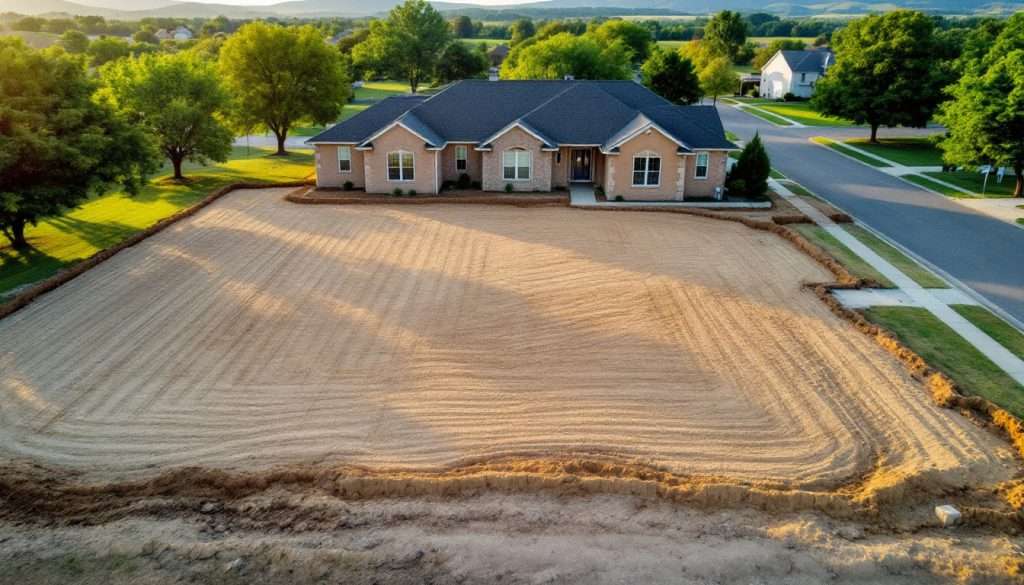
Every fall, right around the time Springfield homeowners start pricing out fescue seed or ordering pallets of sod, we get calls from people who already know something is wrong with their yard. The water puddles near the back door. The front slope washes out every time we get one of those two-inch Ozarks downpours. The previous lawn thinned out in the low spots and never came back. These are not seed problems or sod problems — they are grading problems, and no amount of expensive turf will fix dirt that was never shaped correctly in the first place.
Finish grading is the step between a rough-shaped site and a finished landscape, and when you are establishing a lawn in Greene County, it carries more weight than most people expect. Our soils, our rainfall pattern, and our seeding calendar all conspire to punish shortcuts. Here is how we approach it at SiteForge Excavating LLC, and what you should expect before a single blade of grass goes down.
Most of the Springfield plateau sits on cherty clay loam over limestone, and that combination behaves in two frustrating ways. The clay fraction holds water and refuses to drain vertically, so any depression in your yard becomes a bathtub. The chert — those sharp gravel fragments that seem to multiply every time you till — resists smooth shaping and tears up cheap equipment. Then there is the bedrock. In neighborhoods along the south side near Sunshine and Glenstone, or out toward Battlefield and Republic, shallow limestone can sit two feet below grade or less, which means you often cannot simply cut your way to a better slope. You have to bring in soil and balance it carefully.
On new construction lots, there is an additional problem nobody warns you about. The topsoil that was stripped during site prep often gets hauled off or buried under compacted fill from the foundation excavation. What is left behind is dense subsoil that has been driven over by concrete trucks for six months. Grass roots cannot penetrate it, water cannot infiltrate it, and no amount of fertilizer compensates. Good finish grading includes decompaction and topsoil placement, not just surface smoothing. We cover more of this groundwork in Finish Grading in Springfield, MO: A Pro’s Perspective, which is worth reading if you want the broader picture of how the process fits into a full site build.
The number we aim for around foundations is a drop of six inches over the first ten feet away from the house, which satisfies both common sense and the residential code enforced by Springfield’s Building Development Services. Past that first ten feet, we like to hold a minimum of one to two percent fall across lawn areas so water keeps moving instead of ponding. Flat is not neutral in this climate — flat is a puddle waiting for the next storm.
On the other end, slopes steeper than about three-to-one become a maintenance headache. You cannot safely mow them, sod wants to slide before it roots, and seed washes downhill in the first heavy rain. When a lot forces steeper terrain, which happens often on the hillier parcels around Rogersville, Ozark, and the Galloway Creek corridor, the better answer is usually a terrace, a low retaining wall, or a planted bed rather than turf.
A proper finish grade for lawn establishment typically includes:
Tall fescue is the workhorse lawn grass in southwest Missouri, and the prime seeding window runs from late August through early October. That means finish grading should be wrapping up in the first half of August if you want seed down before the soil cools. Wait too long and you are seeding into November, hoping for a mild winter, and usually reseeding again in spring.
Spring grading is possible but trickier. March and April bring our wettest stretch, and clay soil worked when saturated will smear, seal, and compact in ways that take years to recover from. We would rather push a project two weeks than grade wet clay. If you are installing zoysia or bermuda sod, late May through June works well, and that gives us a dry-ground window in April or early May to shape the site.
Sequence matters. Irrigation lines, landscape lighting, and downspout extensions should go in after rough shaping but before the final topsoil pass, so trenching does not chew up a finished surface. Patios, retaining walls, and driveway edges need to be set first so we can tie grades into fixed elevations rather than guessing. When a homeowner calls us after the concrete is poured and the sprinklers are in, we can still work, but the job takes longer and costs more.
A finish grade done properly disappears. Nobody walks into a yard and compliments the drainage. What they notice is that the grass is uniform, the mower glides, the basement stays dry, and the mulch beds stay where you put them. That is the whole point. We run laser and GPS-guided equipment on larger lots and hand-finish the detail work around foundations, because the last inch is what separates a lawn that thrives from one you fight with every year.
If you are building new in Springfield, Nixa, Ozark, or anywhere across Greene and Christian County, or you are finally ready to fix a yard that has never drained right, get the dirt work scheduled before you commit to turf. Call SiteForge Excavating LLC at (417) 259-6725 for professional Finish grading services.
