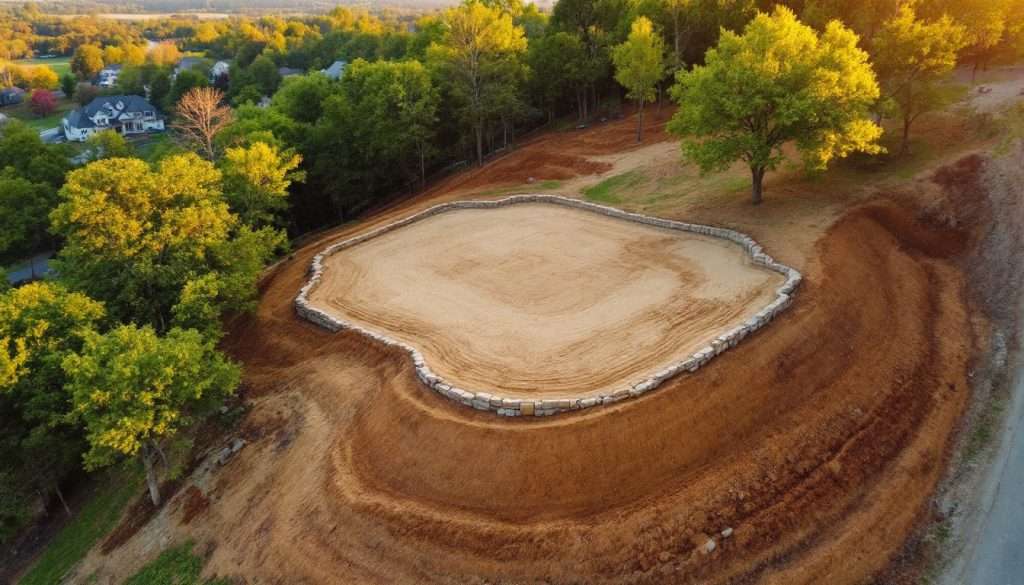
Anyone who has shopped for land around Springfield knows the flattest lots sell first and sell highest. What’s left over — the sidehill parcels off Farm Road 193, the sloping acreage dropping toward the James River, the stepped lots in newer subdivisions out toward Republic and Battlefield — can be excellent property at a fair price, but only if the earthwork is planned honestly before anyone buys. On a sloped lot, the difference between a smart cut and fill plan and a sloppy one can swing the site budget by tens of thousands of dollars. I’ve watched both outcomes happen on parcels less than a mile apart.
The principle behind it is simple enough. Material cut from the high side of a lot gets moved to the low side to build the pad up, and if the volumes match, nothing gets trucked in or hauled off. That’s a balanced site. If you want the fundamentals of how grading plans get built around that idea, we covered them in Cut and Fill Explained: How Springfield, MO Sites Get Shaped. This article is about what changes when the ground tilts.
On a nearly flat site in north Springfield, a foot of grading error costs you a little extra dirt. On a lot falling eight or ten feet across the building footprint, that same error compounds. Push the pad four feet higher and you’re not just adding fill under the slab — you’re extending the fill slope outward, which eats into yard space, pushes toward property lines, and may force a retaining wall you hadn’t budgeted. Drop the pad four feet instead and you pick up a cut slope behind the house that has to be benched, drained, and often walled.
The sweet spot on an Ozarks hillside is usually a daylight basement or walkout configuration, where the cut side becomes the basement wall and the fill side becomes the patio grade. Done right, this cuts earthwork volume dramatically because the structure itself absorbs part of the elevation change. We look for that opportunity on nearly every sloped lot we quote in Greene and Christian County.
Southwest Missouri sits on Burlington-Keokuk limestone with cherty residuum above it, and on a hillside that rock is often closer to the surface than it is in the valley. Soil creep moves material downhill over centuries, so the uphill portion of a sloped lot frequently has a thin soil mantle over bedrock while the downhill portion has deeper, softer accumulated material.
That matters enormously for cut and fill balance. A plan drawn on paper might show 900 cubic yards of cut available on the high side. If 400 of those yards turn out to be solid limestone requiring a hammer or a rock saw, the economics change overnight. Chert and shot rock also behave differently as fill — they compact well and drain beautifully, but they’re not suitable directly beneath a slab without proper processing and lift control. We nearly always recommend test pits or a few borings on sloped lots before finalizing a grading plan. A $1,500 investigation has saved clients $20,000 more times than I can count.
Springfield averages roughly 45 inches of rain a year, and spring storms tend to arrive in heavy, concentrated bursts. Fill placed on a slope is the most vulnerable material on any site. Three things keep it stable:
Skip the benching step and you’ve built a landslide on a schedule. We’ve been called in to repair fill slopes on several properties east of Springfield where a previous contractor simply dumped material on a grassy hillside and tracked it level. The failures showed up during the second wet spring.
The City of Springfield requires a land disturbance permit for projects disturbing an acre or more, and MDNR’s stormwater general permit applies at the same threshold. On sloped sites, inspectors pay particular attention to erosion control because runoff velocity increases with grade. Silt fence alone often won’t cut it — we typically add rock check dams, diversion berms above the work area, and temporary seeding on any fill slope that will sit exposed longer than a couple of weeks.
There’s also the practical matter of where your water goes. Grading a hillside lot changes drainage patterns for everyone downhill of you. In established neighborhoods around Galloway, Sequiota, and the older streets south of Sunshine, downhill neighbors notice immediately. A grading plan that routes concentrated flow into a swale and releases it at the historic discharge point keeps you out of trouble with both the Stormwater Division and the people next door.
Hauling is the expensive part of earthwork. Moving dirt 200 feet across your own lot costs a fraction of what it costs to truck it to a disposal site or import engineered fill from a pit. On a sloped Springfield lot, achieving reasonable balance often means adjusting the pad elevation by a foot or two, rotating the house slightly, or accepting a steeper driveway. Those are design conversations worth having early, while they’re still free to change.
If you’re evaluating a hillside parcel or already own one and need a realistic earthwork plan, we’re glad to walk the ground with you before you commit. Call SiteForge Excavating LLC at (417) 259-6725 for professional Cut and fill services.
